Shrines
Welcome to my shrines!!!
These are all the interests and obsessions that if you distilled, powderize, and then stewed in a massive cauldron of a couple days would create a Kova homunculus (maybe, I'm not actually a trained alchemist). Please don't use this information to create a Kova homunculus... if you do at least send me a pic I'd be a little curious.
There is absolutely no order or priority to any of the items in here as my whims and loves are forever in flux. What I might obsess over today may be far less interesting tomorrow only to come back again a month later as strong as ever.
INFACT this is not even an exhaustive list! I will be adding to and rewritting the many shrines here as this website grows. for this reason ive dated each shrine as i write them so you can get a little assemblage of what im into at the moment.
Seals
 Nick Goodrum (2017) Common Seal [link]
SEALS!!!! I love my fat little water puppies, they are silly little guys and they fill me with joy and whimsy. That's above the water, in the water they are beautiful and graceful artists. They fill me with wonder and amazement as they effortlessly twist and turn.
My favourite seals are the ribbon seal and harbour seal. The ribbon seal is like the fashion star of the phocids; they have such a striking and novel coat. There is competition of course, the spotted seal and leopard seal both have far more interesting coats than others. But to me the ribbon seal is the coolest.
There is just something so perfectly innocent about the face of a harbour seal. It's easily the most adorable of the seals. Yes I know baikal seals have the biggest eyes… I think they are too big, they look permanently sad.
Seals are meant to look happy, they are these round laid back and whimsical critters and I need that. That's also why I do not count the eared seals in this shrine, I have not seen even one that was calm. They scream and flail around, entirely the wrong vibe.
Written: 22-05-26
Gothic Architecture
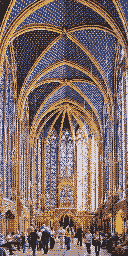 Didier B (2005) Sainte Chapelle - Upper Chapel, Paris, France [link]

My early game was In rural England meaning that while most buildings were centuries old cottages and post war terraced houses, all equally degraded, I was never too far from a truly ancient church, cathedral, or abandoned abby.
I saw something in these 'alien' buildings I couldn't find anywhere else. An expression of form and artistry on a canvas so large to be impossible to see in totality. The idea of a canvas or stage that large sorta destroys the concept of a canvas. the boundary where a work ends lost all meaning. the Details of the space don't diminish as you get further away from the human perspective in gothic architecture. Even at the top of flèches and roofs where no eye can really parse detail there are still beautifully carved pinnacles, grotesques, gargoyles.
This denial of the “rules” of art silently enforced didn't end with space. Those abandoned abbyes that are SO common in England (thanks Henry) can be some of the most ethical and beautiful places to explore. The stories you can build walking around the sculpted skeletal remains of these buildings is captivating.
Gothic Architecture taught me that anything can be made to be art irrespective of function or scale. It informed my art, every space I create tries to capture some of the nature of a gothic building. Scale, detail, shape, and form are all core to my work. Ogival curves especially.
My favorite cases...
- Sainte Chapelle - Its interior is in my mind the most beautiful and bright room in the world. The gold and blue is ironically french.
- Lady Chapel in Westminster Abbey - the combination of pendant and fan vaulting is insane.
- Église Sainte Catherine - made mostly from wood, it is a rare gem today, it looks gorgeous.
- Wells Cathedral - the support struts of the crossing are inspiring in how they hide function.
- Fountain Abbey - the ruins of are captivating, I plan to make art from the photos I look there.
Written: 14-02-26 | Updated: 22-05-26
Tabletop Roleplaying Games

I started my obsession with this flavour of pseudo immersive theatre the way practically every one does these days. Dungeons and Dragons and a few streamed tables.
My first table was a collage “DM school” run by the programming tutor, we played Out of the Abyss and our own homebrewed stories and settings. Within this setting: creating monsters, characters, quests and campaigns, I fell into the conductive role of a games master.
It wasn't much longer till I would be strapped into that chair for eternity. Immediately after leaving college I joined a new table created by a friend of a friend, it was chaotic and had its growing pains but it was here that I got my taste (however short lived) of being a player. My DM soon went on deployment and with nobody else to step up I became the de facto DM for the next 5 years.
Since the end of that campaign I've had the freedom to explore more TTRPGs: Candela Obscure, Vampire the Mascarade, Kids on Brooms, and my own [in development] system. With each of these I've learnt more about what I like in a system and what style of gameplay is most enjoyable to me.
Written: 20-02-26 | Updated: 15-02-26
Death Stranding [Kojima's work in general]

I'm a sucker for a game with an esoteric exterior and a point to argue hidden underneath it. That's why I'm about to yap about Kojima's most contentious game.
Much like how metal gear looks to be a game about homoerotic action heroes and spies, Death Stranding is on the surface a game about being a delivery man in the apocalypse. And like the rest of his work you can take your brain out, play the apocalypse delivery game and take away a fun (or boring if you've destroyed your attention span) experience.
Ultimately it's a game about co-operation and rebuilding your social circle after losing everything. That's not a surprise to some as there are plenty of video essays and blog posts about how PT Silent Hill and leaving Konami impacted Kojima and therefore informed Death Stranding.
But the reason I love death stranding and the rest of Kojima's work is more than esoteric aesthetics and venting meta narratives. Kojima has repeatedly made his games into interventions on how people play games. Whether it’s changing the controller port, being told to turn off the console to complete the mission, or playing a multiplayer game and never seeing another player's avatar, Kojima has forced us to reinterpret our expectations of what gameplay and mechanics are.
And to me Death Stranding is the most interesting of the lot. The Chiral Network system is the latest and bar far loudest addition to a secret world of asynchronous multiplayer mechanics. By separating each player into their own world in which others' choices bleed in; Kojima created a world where your own selfish actions benefit others. Co-operation is the only possible course of action whether you intend it or simply cause it as a byproduct; you are always helping bring strangers up with you, an antithetical to the “crab theory”.
Written: 25-02-26
Dune
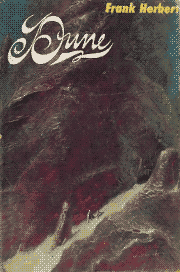 John Schoenherr (1965) First Edition Cover.
Dune is a brilliant intervention of the hero and a hate letter to Isaac Asimov's foundation. I had been aware of it for a very long time thanks to its impact on and its references within like all the sci-fi ever that came after it. But it was in 2021 ish that I was given the first book and got to watch the first Villeneuve Dune.
Since then I've read all 6 of the Frank books watched all the media I can (even the lynch movie) and re-evaluated many of the other sci-fi worlds I’d liked before.
It's clear to me that Frank Herbert desperately wishes for a world free of dependence of any kind. His books portray any form of assistance no matter how necessary as an existential threat. Even the point of wearing glasses is a thing of note that carries connotations within his argument.
Like any other ideology it relies on an idealised perception of societal ability and capacity. That irrespective of system, people should ‘pull themselves up by their bootstraps’ and achieve their goals. There are places where this fear of reliance works and areas I think it doesn't.
The fear of dependence on AI to make decisions is an obvious one, far more so now as people become braindead zombies and corporations remove humans from the decision making process. Frank told us that the ability to do something without thinking carries the most danger. And that this capability would enslave not liberate. Oh how on the money he was.
Written: 22-05-26
Mirrors Edge

Practically everyone of my peers both under and post graduate have some love for this game. The lion's share of projects I've been a part of have had this little Dorfic running game brought up during ideation. So I know I'm not particularly different when I say that it is one of my favourite games.
Both Mirrors Edge & Catalyst capture something primal. Like many games before them they bring the player into a flow state allowing for faster and smoother interactions. Something about the virtual running, exaggerated dangers, and constant sounds of breathing that makes these games a special drug to me.
My favourite chapter in the original game is Jacknife, specifically the sections around and within the water infrastructure. The flood water silo with its many staggered pillars looked so cool and like nothing else I'd seen at the time. Knowing that they have a real world equivalent in the “G-Cans” of Japan makes it all the more cool.
My favourite Mission of Catalist is Benefactor, It's the highest you get to go in the game outside of the final mission. It's in the center of the city too so you get a better idea of scale looking around at the top. Climbing and then ruining a skyscraper is fun but getting to stop and take in the view before racing back down makes this perfect to me.
Written: 15-03-26